How to Teach Citing Text Evidence with the TAGS Strategy
My students were getting marks of one or two on their reading responses. Here’s what changed.
I moved from second grade to fifth grade after a period of nine years, and at the time I thought I knew how to teach reading.
I soon realized that teaching students to read in 2nd grade was quite different from teaching them in 5th grade to write about what they had read.
My students could read the passage and answer the questions out loud, but as soon as I asked them to write a response and provide text evidence, the whole thing fell apart.
Short answers.
Vague answers.
Answers that merely repeated the question without actually providing any proof.
When I asked them to “go back and find evidence”, many of them highlighted half of the passage. That was the problem.
They knew they were supposed to use text evidence. They just didn’t know which evidence actually proved their answer.
I had to create a structure which was simple enough to remember yet strong enough to enable them to produce a full reading response.
That’s when I began using the TAGS reading strategy regularly.
At our mid-year benchmark, our class achieved 83 percent in Vocabulary and 82 percent in Reading, which were our best scores so far.
We didn’t just work on TAGS, since it gave our students something they had previously lacked—a clear system for answering questions, finding evidence, and explaining their thinking.
If you’d like to use it with your students, you can get the free TAGS anchor chart and practice page.
Here’s exactly how it works and how to teach it.
What Is the TAGS Strategy?
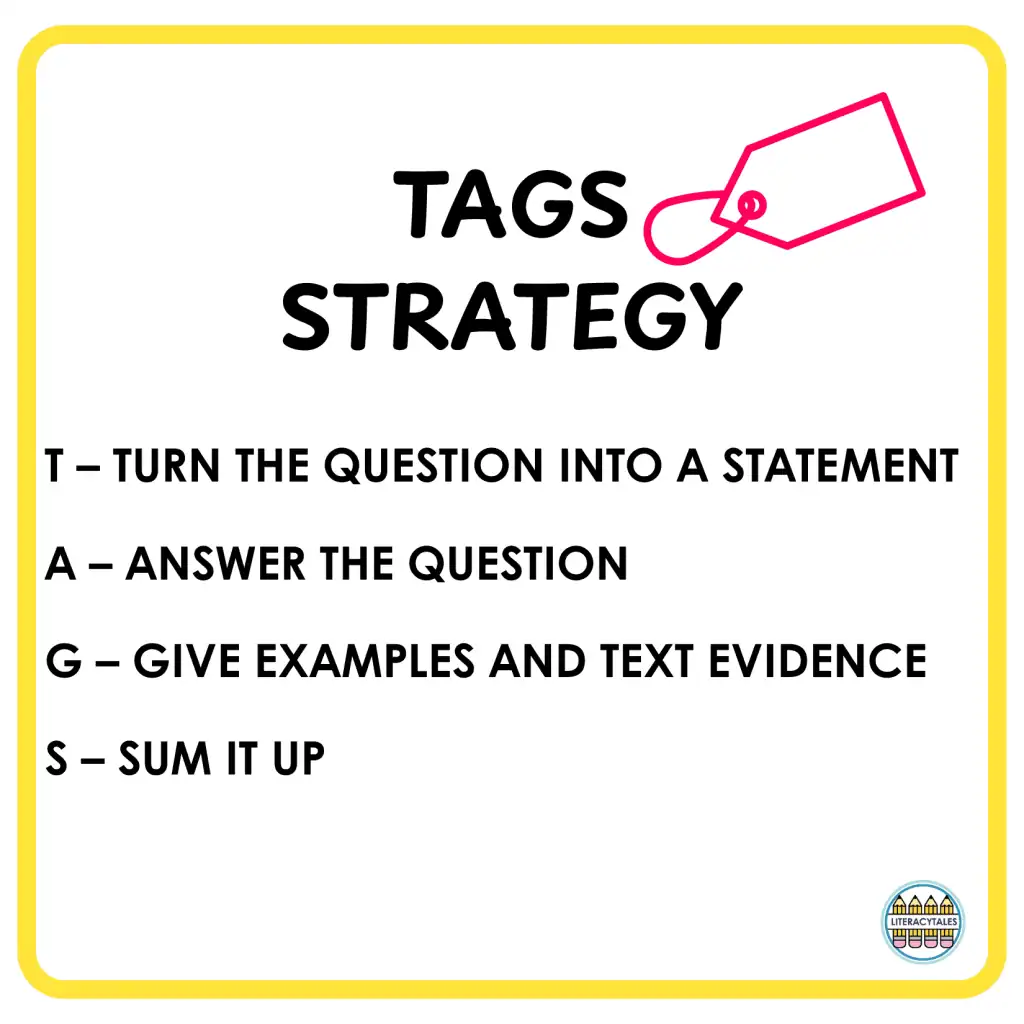
TAGS is a four-step method I use to help students answer reading comprehension questions in writing.
Each letter gives students one job:
- T — Turn the question into a statement
- A — Answer the question
- G — Give text evidence
- S — Sum it up
That’s it. Four steps.
However, these four steps give students a much clearer route than simply advising them to “answer in a complete sentence and use evidence.”
Rather than standing in front of a blank page and wondering what to write next, they know precisely what should come next.
Why Students Struggle With Citing Text Evidence
A major problem that I observed was that my students mixed up significant information with text evidence. They need not be the same thing.
Even if a student highlights three or four interesting points from a paragraph, that doesn’t mean they all prove the answer.
So I started teaching them to ask one question: What sentence actually proves that my answer is correct?
The small change made the G in TAGS more concrete.
Instead of: “Go find evidence.”
I could say: You’ve already given the answer, so go back and locate the sentence that proves it. It gives students a reason to go back to the text.
How I Introduced The TAGS Strategy (Step by Step)
Day 1: Show Them What a Strong Reading Response Looks Like
Before I introduced the strategy, I gave my students some examples of real reading responses.
I took the sample responses from the previous year, printed them out, and then we evaluated them together using a writing rubric. Some scored a 3, and some scored a 1.
My students were a bit surprised at how different things were, and that was precisely the effect that I had hoped for.
They started noticing things like:
- This response answered the question but did not use evidence.
- It took something from the passage but didn’t explain it.
- There was some evidence, but it did not in fact prove the answer.
- It replied, cited evidence, and clearly explained its reasoning.
They could now see exactly what I meant by a strong response.
Day 2: Teach TAGS Explicitly
The following day, I presented the TAGS anchor chart and demonstrated the whole process by using a question from a released state test.
Then I answered it. I told them: “I now know my answer. The next thing I should do isn’t to point out everything that seems important. It is to locate the sentence that proves the point I have just made.”
That became our routine.
Give the answer first and then provide the proof.
We then concluded the explanation of the evidence and completed the response.
I never expected them to work out any part of the process themselves.
I modeled exactly what each step looked like on paper.
Day 3: Practice Together, Then Independently
We looked at two passages together and worked on analyzing the questions before writing them.
For each response, we came to the G. I asked: What are we trying to prove?
Then: What part of the text most clearly shows it? Instead of just citing a sentence, the students were required to give a reason for their choice of evidence.
After the guided exercise, I gave them a new reading prompt and asked them to complete their response on their own using TAGS.
They applied the rubric to their own writing. The majority of them rated themselves a 1 or 2.
That was, in fact, one of the most useful sections of the lesson. They were able to see what was missing and wanted to correct it.
How I Teach the G: Give Text Evidence
The G section is where a great deal of support is needed by students.
I present it as a straightforward process.
1. Answer the Question: Students should know what they are trying to prove before they go hunting through the passage.
If the question asks: Why did Maya hesitate before walking onto the stage? A student might answer: Maya hesitated because she was nervous about performing in front of the audience. Now they have something specific to prove.
2. Go Back to the Text: Students reread the part of the passage connected to the question.
They are not looking for every important detail. They are looking for evidence connected directly to their answer.
3. Ask: Which Sentence Proves My Answer? This is the question I want students to hear in their heads every time. Which sentence proves my answer? If three sentences are related to the topic, students compare them and choose the strongest one.
4. Cite the Evidence. Then students bring that evidence into their response.
Depending on the grade level and assignment, they might use a sentence stem such as:
- The text states…
- According to the passage…
- One detail that shows this is…
- The author explains…
- The text says…
The sentence stem is helpful, but it is not the most important part. The most important part is choosing relevant evidence.
5. Explain the Evidence
This is the part students often skip. They give the quote or detail and think they are finished.
I remind them: Evidence proves. Your explanation tells me how it proves. That means students need to connect the evidence back to their answer.
Text Evidence Sentence Stems for Grades 3–5
Sentence stems can be especially helpful when students understand the passage but struggle to begin writing.
Here are a few I use:
To introduce evidence:
- The text states…
- According to the passage…
- One detail that supports this is…
- The author says…
- In the text…
To explain evidence:
- This shows…
- This proves…
- This means…
- This detail supports my answer because…
- From this, I can tell…
I don’t want students depending on sentence stems forever. But while they are learning how a complete evidence-based response works, the stems give them one less thing to worry about.
Common Text Evidence Mistakes
Once students begin using TAGS regularly, these are the mistakes I watch for most.
Highlighting Too Much: If half the passage is highlighted, students probably haven’t decided what they are actually trying to prove. Go back to the question and answer it first.
Copying Without Explaining: A quote by itself is not a complete explanation.
Ask: How does this evidence prove your answer?
Choosing a Detail That Is Related but Does Not Prove the Answer
This one takes practice. A detail can be about the same character or topic and still not be strong evidence for that specific question.
Restating the Question and Stopping
Turning the question into a statement is only the T. Students still need A, G, and S.
Using Too Much Evidence: More evidence does not automatically make a response stronger.
For many short reading responses, one strong piece of evidence, clearly explained, is better than three random quotes.
How TAGS Became Part of Our Daily Reading Routine
Once my students understood the structure, TAGS became part of our regular reading routine.
We used it during:
- Morning warm-ups
- Reading comprehension practice
- Exit tickets
- Small groups
- Test prep
- Written responses
Some days, we looked at a sample answer together and searched for the missing piece.
“Where is the text evidence?”
“Did this evidence actually prove the answer?”
“Where is the explanation?”
Other days, students color-coded their own writing so they could see each part of TAGS. Over time, their responses became longer, more focused, and much easier to follow. The students who used to write one sentence had a way to build a full paragraph. Not because I told them to “write more.” Because they knew what came next.
Want the TAGS anchor chart and practice page I use to introduce the strategy?
Why TAGS Works for Grades 3–5
What I like about TAGS is that the structure can grow with students.
A third grader might use TAGS to answer one reading comprehension question with one piece of evidence.
A fifth grader might use the same structure to respond to paired texts or begin building a longer literary analysis response.
The reading gets harder. The questions get more complex. The evidence gets stronger. But the basic thinking stays the same:
Answer it. Prove it. Explain it.
TAGS can also help students who understand what they read but struggle to organize their writing.
Sometimes the problem is not comprehension. They simply do not know how to get their thoughts onto the page. Giving them a repeatable structure reduces that uncertainty.
TAGS and Close Reading Work Together
TAGS also fits naturally into close reading. During close reading, students reread with a purpose, annotate important information, discuss the text, and go back to specific details.
TAGS gives them a structure for what happens after all of that thinking. They can take what they noticed during close reading and turn it into a focused written response.
If your students also need help with rereading and annotation, read my guide on How to Teach Close Reading in 7 Simple Steps.
Ready-to-Use TAGS Resources
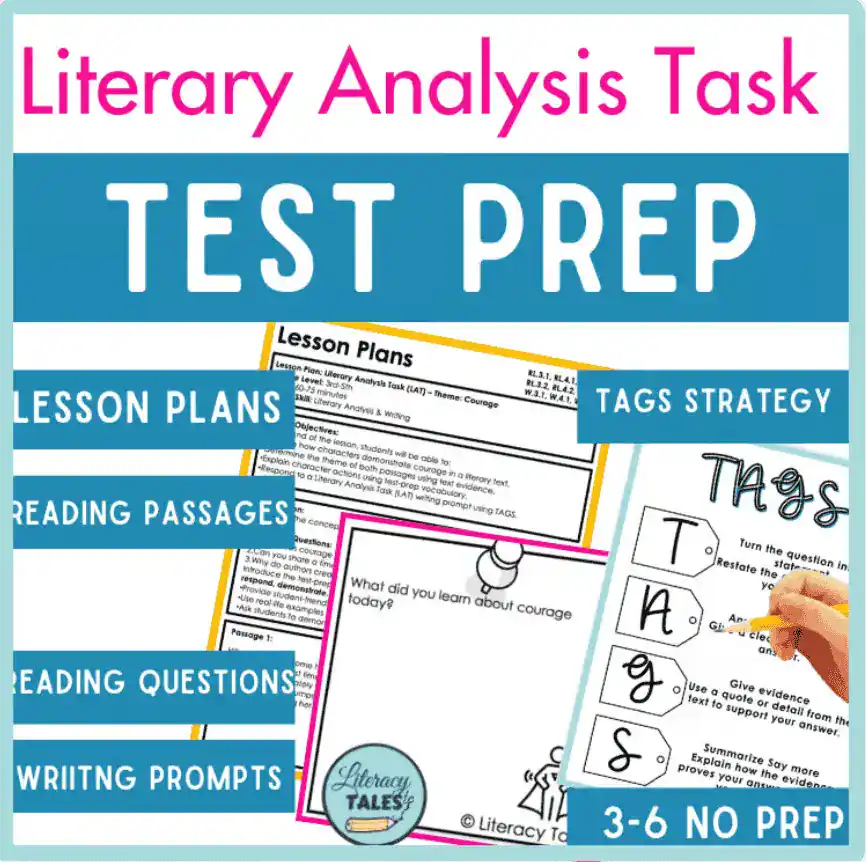
If you want to skip some of the setup and give students more structured practice, my Literary Analysis Task ELA Test Prep pack includes TAGS practice, reading passages, rubrics, and structured written responses.
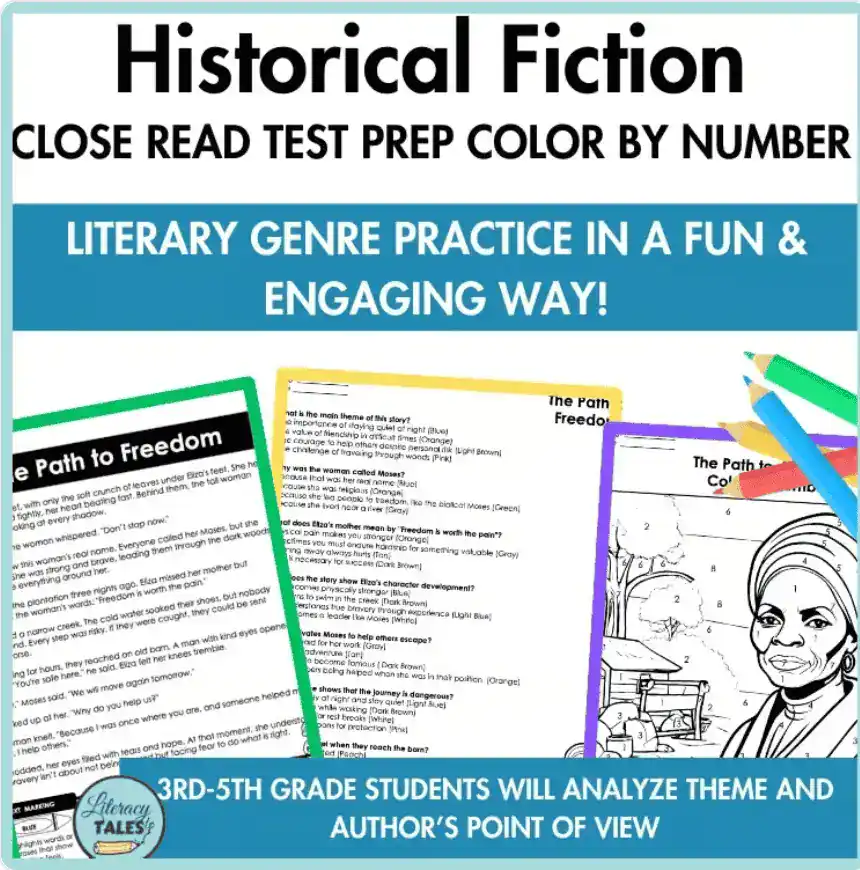
If your students need more practice with skills such as theme, inference, and author’s point of view, my Historical Fiction Color by Number Reading Resource gives them another way to practice reading closely before responding.
If you want to introduce the strategy first, start with the free version.
Grab the TAGS anchor chart and practice page here → Get the free TAGS resource
Want More Reading Comprehension Strategies?
If TAGS works for your kids, you’ll want the full system. One strategy taught consistently is good. A daily reading routine built around it is what moves the benchmark numbers.
Shop Reading Comprehension Resources at LiteracyTales
Frequently Asked Questions About Citing Text Evidence
What does citing text evidence mean?
It means using a detail from the text to prove an answer.
How do you teach students to cite text evidence?
Have students answer first, find the evidence that proves it, then explain how it connects.
What are good sentence starters for text evidence?
Try: “The text states…,” “According to the passage…,” or “One detail that shows this is…”
How do I stop students from highlighting too much?
Have them answer the question first, then find only the sentence that best proves their answer.
Does text evidence have to be a direct quote?
No. Students can quote the text or use a specific detail in their own words.
How much text evidence should students use?
For many short responses, one strong piece of evidence with a clear explanation is enough.
Tehfe – Fifth-Grade ELA and Social Studies Teacher
Creator of LiteracyTales
This post may contain affiliate links. All opinions are always 100% mine, and I don’t work with any product or company I don’t use and love.