How to Use Mentor Texts to Teach Writing in 3rd–5th Grade (With a Free Lesson Plan)
The Day EACH KINDNESS INSPIRED MAYA….

I had a student, let’s call her Maya, who refused to write. Every writing block, she’d sit there with a blank page, pencil down, convinced she had nothing to say. Then, I had to think about how to help Maya. Mentor texts for writing would become the best strategy.
Monday morning, I pulled out Each Kindness by Jacqueline Woodson. I read it aloud. No worksheets. No graphic organizer yet. Just the book.
When I finished, Maya raised her hand. “Can I write about that feeling?” she asked. “When you wish you’d done something different?”
She wrote two full pages. Her best piece all year.
That’s what a good mentor text does. It cracks something open in a kid who thought they had nothing to say.
But here’s what I’ve learned after years of using mentor texts in my 3rd–5th grade classroom: it’s not just about picking a great book. It’s about how you use it. A mentor text that just gets read aloud and then shelved? That’s a missed opportunity. Here’s exactly how I make them work for reading AND writing — every single time.
What Is a Mentor Text, Really?
A mentor text is any piece of writing you use to show students how good writing works, such as picture books, essays, short passages, or even a single paragraph. You’re not just reading it. You’re using it as a model.
It could be fiction or nonfiction. Long or short. The only requirement: it does something with language that you want your students to try.
I always keep a stack of 5–6 go-to mentor texts for each writing unit. That way, I’m not scrambling the night before a lesson.
Step 1: Read It First, Just for the Story
Before you ever say the word “craft,” read the whole thing aloud. Let your kids just be with it.
Resist the urge to stop and ask comprehension questions on the first read. Let them respond naturally. Watch their faces. That emotional response is the hook — it’s what makes them want to write something of their own.
After the first read, ask one open question: “What did you notice?”
You’ll be surprised by what they catch on their own. Read how to Teah Close Read in 7 Simple Steps.
Step 2: Go Back In and Name the Craft
The second read is where the teaching happens.
Pick one specific craft move to focus on — not three, not five. One. Maybe it’s how the author uses short sentences to build tension. Maybe it’s the way a character’s feelings are shown through action instead of just stated.
Name it clearly: “Did you notice how the author never said she was sad? She showed it. Let me show you where.”
Step 3: Try It Together Before They Try It Alone
After you’ve named the craft move, write a sample sentence or two together as a class. Model your thinking out loud.
“I’m going to try what this author did. Instead of writing ‘she was nervous,’ I’m going to show it. Watch.”
Write it in front of them. Mess up. Cross things out. Let them see that writing is a process, not a performance.
Then give them a prompt connected to the mentor text and let them try it. Keep the prompt tight and specific — not “write a story” but “write a moment where a character shows how they feel without saying it directly.”
Step 4: Use It More Than Once
This is the move most teachers skip, and it’s the one that makes the biggest difference.
Come back to the same mentor text over 2–3 days. Day 1: read for enjoyment. Day 2: study the craft. Day 3: apply it and share.
When students hear a text multiple times, they start to own it. They reference it in their own writing. They say things like “I did what the author did in that book.”
That’s the goal. That’s when you know it clicked.
Which Mentor Texts Actually Work for 3rd–5th Grade?
Here are a few that never fail in my classroom:
- Each Kindness by Jacqueline Woodson — showing emotion through action, point of view, regret
- The One and Only Ivan by Katherine Applegate — voice, figurative language, short, powerful sentences
- Crow Call by Lois Lowry — sensory details, character relationship, setting
- Frindle by Andrew Clements — humor, dialogue, narrator voice
- Encounter by Jane Yolen — perspective, nonfiction/fiction blend, strong leads
Any of these will give you at least 3–4 different craft lessons in one book.
Want a ready-to-use mentor text lesson plan you can run this week?
I put together a free Mentor Text Mini Lesson Plan. It walks you through the 4-step process above using a fill-in template you can apply to any book you already have. No prep needed beyond what you’re already doing.
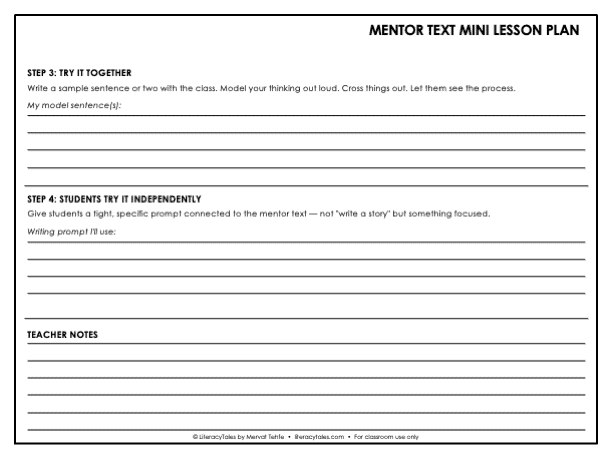
Grab the Free Mentor Text Lesson Plan Here
It’s a one-page PDF. Print it, fill it in with your book of choice, and you’re ready to go on Monday.
If mentor texts are your thing, you’ll love what’s inside my resource library. I build mentor text activity packs for 3rd–5th grade — close reading, writing response, vocabulary, and craft studies — all tied to specific books, so you’re not starting from scratch every unit.
Grab your free reading & writing freebie here
VISIT MT TPT STORE FOR READING & WRITING RESOURCES
JOIN MY NEWSLETTER FOR MORE FREEBIES, GIVEAWAYS, TIPS & TRICKS
Mentor texts work because they show students what’s possible
before they try it themselves. You don’t need a perfect lesson.
You need a good book, one craft move, and a class full of kids
who are ready to try. Start with what you have. Your students
will surprise you.
— Mervat | LiteracyTales | 5th Grade ELA Teacher
This post may contain affiliate links. All opinions are always 100% mine, and I don’t work with any product or company I don’t use and love.
M.Tehfe